| Uploader: | Arpad-Robert |
| Date Added: | 10.09.2017 |
| File Size: | 21.30 Mb |
| Operating Systems: | Windows NT/2000/XP/2003/2003/7/8/10 MacOS 10/X |
| Downloads: | 40058 |
| Price: | Free* [*Free Regsitration Required] |

(PDF) Healthcare and Hospital Management (Edited book) Excel | blogger.com Reddy - blogger.com
Oct 12, · Summary Neal Scott may die in prison. A year-old Black man from New Orleans, Neal had cycled in and out of prison for drug possession over Oct 06, · The latest edition of an ASHRAE Standard may be purchased from the ASHRAE website (blogger.com) or from ASHRAE Customer Service, Tullie Circle, NE, Atlanta, GA E DeGarmo's Materials and Processes in Manufacturing 11th E2d. Fayaz Zaman. Download PDF. Download Full PDF Package. This paper. A short summary of this paper. 22 Full PDFs related to this paper. READ PAPER. DeGarmo's Materials and Processes in Manufacturing 11th E2d. Download. DeGarmo's Materials and Processes in Manufacturing 11th E2d
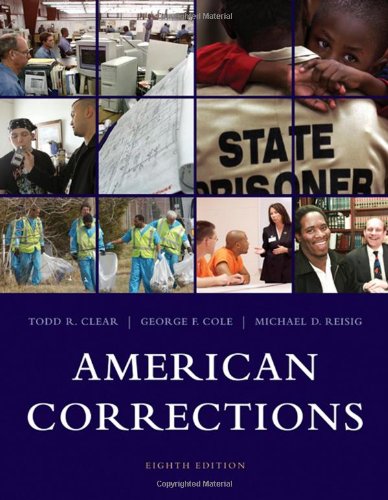
American corrections 11th edition pdf download
Help us continue to fight human rights abuses. Please give now to support our work. Neal Scott may die in prison. A year-old Black man from New Orleans, Neal had cycled in and out of prison for drug possession over a number of years. He said he was never offered treatment for his drug dependence; instead, the criminal justice system gave him time behind bars and felony convictions—most recently, five years for possessing a small amount of cocaine and a crack pipe.
When Neal was arrested in Mayhe was homeless and could not walk without pain, struggling with a american corrections 11th edition pdf download autoimmune disease that required routine hospitalizations. Neal eventually pled guilty because he would face a minimum of 20 years in prison if he took his drug possession case to trial and lost.
He told us that he cried the day he pled, because he knew he might not survive his sentence. Just short of her 30th birthday, Nicole Bishop spent three months in jail in Houston for heroin residue in an empty baggie and cocaine residue inside a plastic straw.
Although the prosecutor could have charged misdemeanor paraphernalia, he sought felony drug possession charges instead. They would be her first felonies. Nicole was separated from her three young children, including her breastfeeding newborn.
Nicole finally accepted a deal from the prosecutor: she would do seven months in prison in exchange for a guilty plea for the 0. She would have trouble finding a job and would not be able to have her name on the lease for the home she shared with her husband. She would no longer qualify for the food stamps she had relied on to help feed her children.
As she told us, she would end up punished for the rest of her life. Every 25 seconds in the United States, someone is arrested for the simple act of possessing drugs for their personal use, just as Neal and Nicole were.
Around the country, police make more arrests for drug possession than for any other crime. More than one of every nine arrests by state law enforcement is for drug possession, amounting to more than 1.
As a result of these arrests, american corrections 11th edition pdf download, on any given day at leastmen and women are behind bars in the United States for drug possession, some 48, of them in state prisons and 89, in jails, most of the latter in pretrial detention. Each day, tens of thousands more are convicted, cycle through jails and prisons, and spend extended periods on probation and parole, often american corrections 11th edition pdf download with crippling debt from court-imposed fines and fees.
Their criminal records lock them out of jobs, housing, education, welfare assistance, voting, and much more, and subject them to discrimination and stigma. The cost to them and to their families and communities, as well as to the taxpayer, is devastating. Those impacted are disproportionately communities of color and the poor. This report lays bare the human costs of criminalizing personal drug use and possession in the US, focusing on four states: Texas, Louisiana, Florida, and New York, american corrections 11th edition pdf download.
Drawing from over interviews with people arrested and prosecuted for their drug use, attorneys, officials, activists, and family members, and extensive new analysis of national and state data, the report shows how criminalizing drug possession has caused dramatic and unnecessary harms in these states and around the country, both for individuals and for communities that are subject to discriminatory enforcement.
There are injustices and corresponding harms at every stage of the criminal process, harms that are all the more apparent when, as often happens, police, prosecutors, or judges respond to drug use as aggressively as the law allows.
This report covers each stage of that process, beginning with searches, seizures, and the ways that drug possession arrests shape interactions with and perceptions of the police—including for the family members and friends of individuals who are arrested. Finally, through many stories, we recount how american corrections 11th edition pdf download the long-term consequences of incarceration and a criminal record that follow a conviction for drug possession can be—separating parents from young children and excluding individuals and sometimes families from welfare assistance, american corrections 11th edition pdf download, public housing, voting, employment opportunities, and much more.
Families, friends, and neighbors understandably want government to take actions to prevent the potential harms of drug use and drug dependence. Yet the current model of criminalization does little to help people whose drug use has become problematic. Treatment for those who need and want it is often unavailable, and criminalization tends to drive people who use drugs underground, making it less likely that they will access care and more likely that they will engage in unsafe practices that make them vulnerable to disease and overdose.
While governments have a legitimate interest in preventing problematic drug use, the criminal law is not the solution. Criminalizing drug use simply has not worked as a matter of practice.
The criminalization of drug use and possession is also inherently problematic because it represents a restriction on individual rights that is neither necessary nor proportionate to the goals it seeks to accomplish.
It punishes an activity that does not directly harm others. Instead, governments should expand public education programs that accurately describe the risks and potential harms of drug use, including the potential to cause drug dependence, and should increase access to voluntary, affordable, and evidence-based treatment for drug dependence and other medical and social services outside the court and prison system.
This report shows that although taking on parts of the problem—such as police abuse, long sentences, and marijuana reclassification—is critical, it is not enough: Criminalization is simply the wrong response to drug use and needs to be rethought altogether.
Human Rights Watch and the American Civil Liberties Union call on all states and the federal government to decriminalize the use and possession for personal use of all drugs and to focus instead on prevention and harm reduction. Until decriminalization has been achieved, we urge officials to take strong measures to minimize and mitigate the harmful consequences of existing laws and policies.
The costs of the status quo, as this report shows, are too great to bear. All US states and the federal government criminalize american corrections 11th edition pdf download of illicit drugs for personal use.
While some states have decriminalized possession of small amounts of marijuana, other states still make marijuana possession a misdemeanor or even a felony.
In 42 states, possession of small amounts of most illicit drugs other than marijuana is either always or sometimes a felony offense. Only eight states and the District of Columbia make possession of small amounts a misdemeanor. Not only do all states criminalize drug possession; they also all enforce those laws with high numbers of arrests and in racially discriminatory ways, as evidenced by new analysis of national and state-level data obtained by Human Rights Watch.
More than one of nine arrests by state law enforcement are for drug possession, amounting to more than 1. While the bulk of drug possession arrests are in large states such as California, which made close toarrests for drug possession inMaryland, Nebraska, and Mississippi have the highest per capita drug possession arrest rates.
Nationwide, rates of arrest for drug possession range from perpeople in Maryland to 77 peramerican corrections 11th edition pdf download, in Vermont. Despite shifting public opinion, innearly half of all drug possession arrests overwere for marijuana possession.
By comparison, there werearrests for violent crimes which the FBI defines as murder, non-negligent manslaughter, rape, robbery, and aggravated assault. This means that police made more arrests for simple marijuana possession than for all violent crimes combined. Data presented for the first time in this report shows stark differences in arrest rates for drug possession even within the same state.
For example, data provided to us by Texas shows that 53 percent of drug possession arrests in Harris County in and around Houston were for marijuana, compared with 39 percent in nearby Dallas County, despite similar drug use rates in the two counties. In New York State, the counties with the highest drug possession arrest rates by a large margin were all in and around urban areas of New York City and Buffalo.
In Florida, the highest rates of arrest were spread around the state in rural Bradford County, urban Miami-Dade County, Monroe County the Keysrural Okeechobee County, and urban Pinellas County.
In Texas, counties with the highest drug possession arrest rates were all small rural counties. Kenedy County, for example, has an adult population of people, yet police there made arrests for drug possession between and In each of these states, there is little regional variation in drug use rates.
The sheer magnitude of drug possession arrests means that they are a defining feature of the way certain communities experience police in the United States, american corrections 11th edition pdf download. For many people, american corrections 11th edition pdf download, drug laws shape their interactions with and views of the police and contribute to a breakdown of trust and a lack of security. This was particularly true for Black and Latino people we interviewed. Over the course of their lives, white people are more likely than Black people to use illicit drugs american corrections 11th edition pdf download general, as well as marijuana, cocaine, heroin, methamphetamines, and prescription drugs for non-medical purposes specifically.
Data on more recent drug use for example, american corrections 11th edition pdf download, american corrections 11th edition pdf download the past year shows that Black and white adults use illicit drugs other than marijuana at the same rates and that they use marijuana at similar rates.
Yet around the country, Black adults are more than two-and-a-half times as likely as white adults to be arrested for drug possession. InBlack adults accounted for just 14 percent of those who used drugs in the previous year but close to a third of those arrested for drug possession. In the 39 states for which we have sufficient police data, Black adults were more than four times as likely to be arrested for marijuana possession than white adults.
In every state for which we have sufficient data, Black adults were arrested for drug possession at higher rates than white adults, and in many states the disparities were substantially higher than the national rate—over 6 to 1 in Montana, Iowa, and Vermont. In Manhattan, Black people are nearly 11 times more likely than white people to be arrested for drug possession.
Darius Mitchell, a Black man in his 30s, american corrections 11th edition pdf download, was among those targeted in Louisiana. An officer pulled him over, claiming he was speeding. When Darius said he was sure he was not, american corrections 11th edition pdf download officer said he smelled marijuana. He asked whether he could search, and Darius said no. Another officer and a canine came and searched his car anyway.
Darius said that he had driven her to the emergency room after an accident, and she had been prescribed hydrocodone, which she forgot in the car. Still, the officers arrested him and he was prosecuted for drug possession, his first felony charge. He faced up to five years in prison. Darius was ultimately acquitted at trial, but months later he remained in financial debt from his legal fees, was behind in rent and utilities bills, and had lost his cable service, television, and furniture.
He still had an arrest record, and the trauma and anger of being unfairly targeted. We interviewed over people in Texas, Louisiana, Florida, and New York who were prosecuted for small quantities of drugs—in some cases, fractions of a gram—that were clearly for personal use. Particularly in Texas and Louisiana, prosecutors did more than simply pursue these cases—they often selected the highest charges available and went after people as hard as they could.
Data presented here for the first time suggests that inmore than 78 percent of people sentenced to incarceration for felony drug possession in Texas possessed under a gram. Possibly thousands more were prosecuted and put on probation, potentially with felony convictions. In Dallas County, the data suggests that nearly 90 percent of possession defendants sentenced to incarceration were for under a gram.
The majority of the 30 defendants we interviewed in Texas had substantially less than a gram of illicit drugs in their possession when they were arrested: not 0. One defense attorney in Dallas told us a client was charged with drug possession in December for 0. The margin of error for the lab that tested it is 0. Bill Moore, a year-old man in Dallas, is serving a american corrections 11th edition pdf download prison sentence for 0. In Fort Worth, Hector Ruiz was offered six years in prison for an empty bag that had heroin residue weighing 0.
In the most recent year for which national data is availablemore than 99 percent of people convicted of drug possession in the 75 largest US counties pled guilty. Our interviews and american corrections 11th edition pdf download analysis suggest that in many cases, high bail—particularly for low-income defendants—and the threat of long sentences render the right to a jury trial effectively meaningless. Data we obtained from Florida and Alabama reveals that, at least in those two states, the majority of drug possession defendants were poor enough to qualify for court-appointed counsel.
American corrections 11th edition pdf download lower-income defendants, such high bail often means they must remain in jail until their case is over. They both said she had a strong case that could be won in pretrial motions, but her attorney had been waiting months for the police records, american corrections 11th edition pdf download, and Breanna needed to return home to her 9-year-old daughter. In New York City, Deon Charles told us he pled guilty because his daughter had just been born that day and he needed to see her.
Imagine me in here for 20 years. They got people that kill people. And they put you up here for half a gram of weed. For the minority of people we interviewed who exercised their right to trial, the sentences they received in Louisiana and Texas were shocking.
Inside The Twin Towers
, time: 1:31:49American corrections 11th edition pdf download

DeGarmo's Materials and Processes in Manufacturing 11th E2d. Fayaz Zaman. Download PDF. Download Full PDF Package. This paper. A short summary of this paper. 22 Full PDFs related to this paper. READ PAPER. DeGarmo's Materials and Processes in Manufacturing 11th E2d. Download. DeGarmo's Materials and Processes in Manufacturing 11th E2d Webster's Dictionary is any of the dictionaries edited by Noah Webster in the early nineteenth century, and numerous related or unrelated dictionaries that have adopted the Webster's name. "Webster's" has become a genericized trademark in the U.S. for dictionaries of the English language, and is widely used in English dictionary titles. Merriam-Webster is the corporate heir to Noah Webster's Oct 12, · Summary Neal Scott may die in prison. A year-old Black man from New Orleans, Neal had cycled in and out of prison for drug possession over

No comments:
Post a Comment